Video over Fiber · 4K HDMI
4K HDMI over fiber, down to a dongle
Four 4K HDMI models including the Micro Mini format — a transmitter the size of a thumb drive — for 4K sources that sit nowhere near their displays.
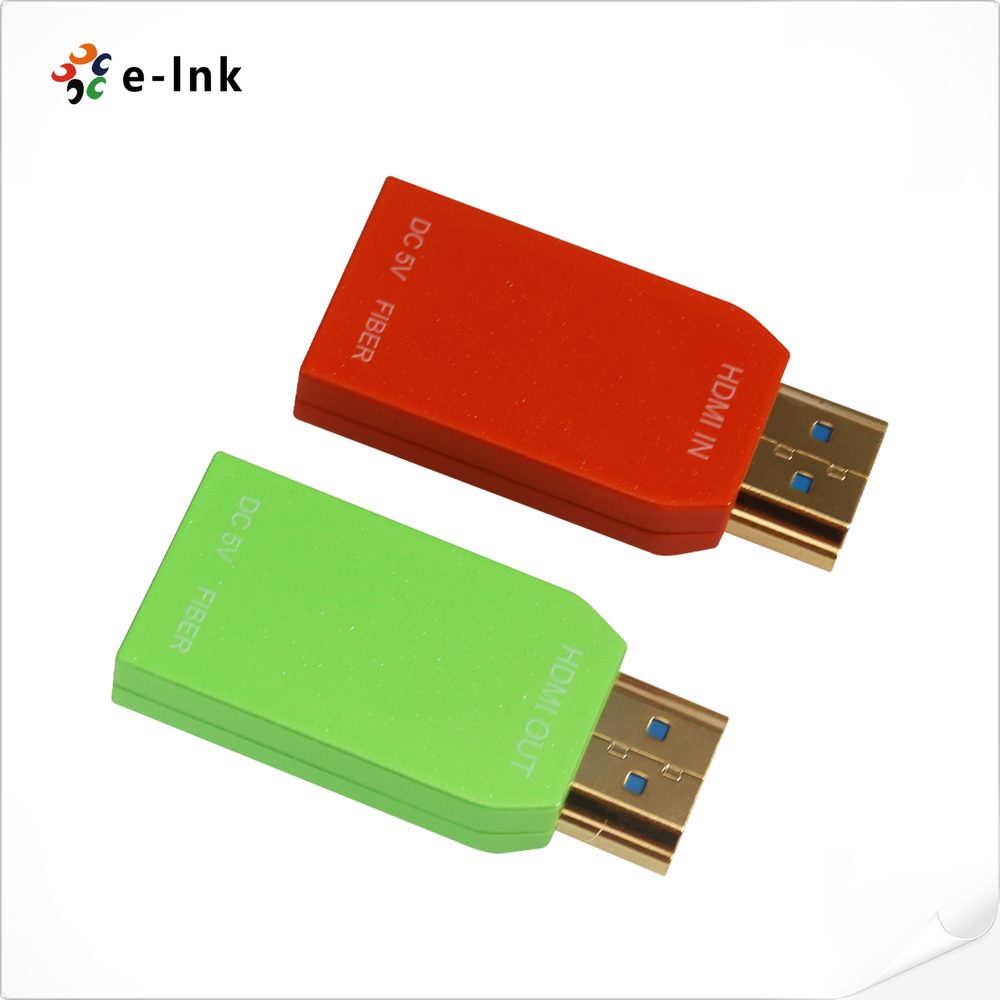
Four 4K HDMI models including the Micro Mini format — a transmitter the size of a thumb drive — for 4K sources that sit nowhere near their displays.
4K changed HDMI extension twice over. The signal is four times the data of 1080p, so copper options shrink further; and the sources changed — laptops, media players, cameras and mini-PCs that live on desks and lecterns rather than in racks. A rack-format extender pair is the wrong physical answer for a source that gets unplugged twice a day. This family answers with four 4K models, headlined by the Micro Mini 4K HDMI Fiber Extender format: the transmitter is a dongle that plugs straight into the source's HDMI port and takes its fiber out the back.
The colour-coded transmitter/receiver pairing (the red-in, green-out pattern shown in the catalogue photography) is a small design decision with a real operational payoff: in a venue with several 4K links, the ends identify themselves. For fixed installations, the family's full-size 4K converters — including the 4K HDMI 2.0 4:4:4 fiber extender documented in the wider HDMI family — give the rack-mounted alternative.
| Model (official product name) | Series | Documentation |
|---|---|---|
| Micro Mini 4K HDMI Fiber Extender | LNK-MH4K | Specification captured from the official product page |
| Micro Mini 4K HDMI Fiber Extender with External Audio | LNK-MHA4K | Specification captured from the official product page |
| Mini 4K HDMI Fiber Extender with RS232 & External Audio | — | Full specification confirmed per model at quotation |
| Mini 4K/30Hz HDMI over Single-Core Multimode Fiber Extender | — | Full specification confirmed per model at quotation |
The complete 4K HDMI over fiber family (4 models) as listed in the manufacturer's catalogue; the 4K DVI models are covered on the DVI page.
4K/30 and 4K/60, 4:2:0 and 4:4:4 chroma, are different loads on an extender. State the exact format your sources produce and your displays accept; the model shortlist and the written confirmation are built on that, not on the word '4K'.
Choose the micro format when the source is portable or space at the source is zero (lecterns, camera rigs, signage players mounted behind screens). Choose full-size units when the source end is a rack with power, other signals to combine, or a need for loop-out.
Micro transmitters draw power at the source end (the catalogue photography shows the DC 5V feed on the dongle). Confirm the power arrangement for your source device as part of the quotation.
Yes — transmitter and receiver are distinct ends (the colour coding marks them). Order them as pairs; a receiver cannot substitute for a transmitter.
Not in the micro format. If the display end needs USB (touch, keyboard), step up to the KVM over fiber family, which is built for exactly that pattern at its rated formats.
The dongle takes a fiber connector at its rear; the module and fiber type are model specifics — confirm against your installed fiber before payment.
Send the model name, the distance, the fiber type and the quantity. We will confirm the matching transmitter/receiver pairing, the optical module and the full specification of the exact model in writing before you pay.